How to Become an SDET: A Practical Roadmap for Manual Testers
A step-by-step roadmap from manual tester to SDET: the skills to learn in order, the portfolio projects that impress, and how to prepare for interviews.
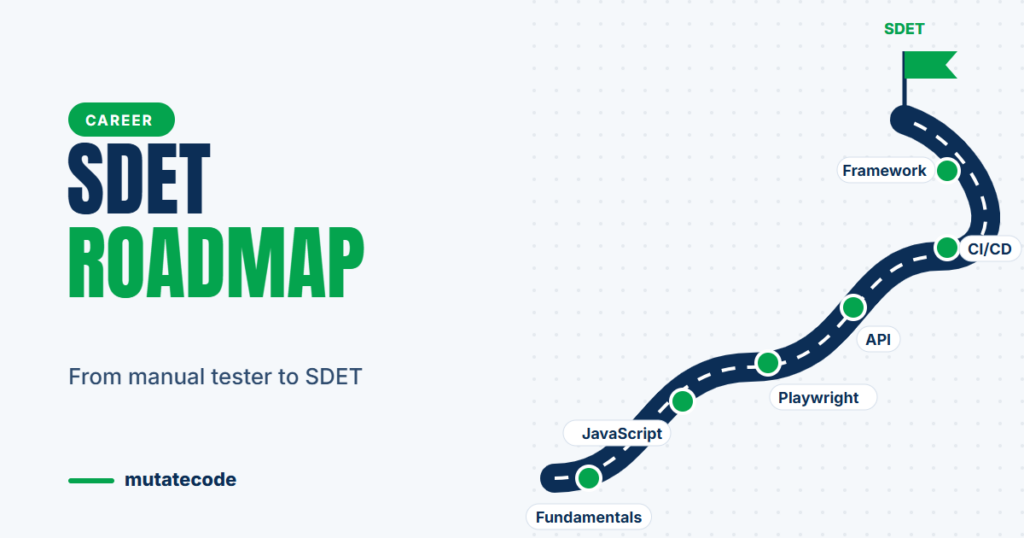
Many manual testers want to move into automation but do not know where to start. The internet offers hundreds of tools and courses, and it is easy to spend months learning things in the wrong order. This roadmap gives you a clear sequence, from testing fundamentals to a portfolio that gets interviews, based on what Software Development Engineers in Test (SDETs) actually do day to day.
What is an SDET?
An SDET is an engineer who builds and maintains the systems that test software. Compared with a traditional automation tester, an SDET is expected to write production-quality code, design test frameworks, work inside CI/CD pipelines and decide what should be tested at which level: unit, API or UI.
| Manual tester | Automation tester | SDET | |
|---|---|---|---|
| Main focus | Exploring and verifying features | Automating existing test cases | Designing test systems and quality strategy |
| Code | Little or none | Scripts | Maintainable framework code |
| Works with | Test cases, bug trackers | Automation tool | Framework, APIs, CI/CD, containers |
Your manual testing experience is an advantage, not something to leave behind. Knowing what to test, how users behave and where bugs hide is exactly what many developers lack.
The roadmap
Step 1: Strengthen testing fundamentals
Make sure you can confidently explain the SDLC and STLC, test design techniques such as boundary values and equivalence partitioning, the test pyramid, and the difference between smoke, sanity and regression testing. Interviewers test these first, and they guide every automation decision you will make.
Step 2: Learn one programming language properly
Pick one language and go deeper than syntax. For modern web automation, JavaScript followed by TypeScript is a strong choice because it is the language of the web and of Playwright. Focus on:
- Variables, functions, arrays and objects
- Asynchronous code: promises and
async/await - Modules, error handling and classes
- TypeScript types and interfaces
Step 3: Master one UI automation framework
Learn Playwright thoroughly: locators, auto-waiting, assertions, fixtures, authentication and configuration. Depth beats breadth: one framework you understand completely is worth more than five you have only tried.
Step 4: Add API testing
Most modern applications are built on APIs, and API tests are faster and more stable than UI tests. Learn HTTP methods, status codes, headers and authentication, then automate API checks and combine them with UI tests.
Step 5: Learn version control and CI/CD
SDETs work like developers. Learn Git branching, pull requests and code review, then run your tests in a pipeline such as GitHub Actions with reports and artifacts. Add the basics of Docker so you can run tests in containers.
Step 6: Design a framework
This is the step that separates SDETs from script writers. Build a framework with a clear structure: page objects or components, fixtures, API clients, test data factories, configuration per environment, reporting and parallel execution. For every part, be able to explain why it exists.
Step 7: Use AI tools responsibly
AI assistants are now part of the job. Learn to use them for test ideas, data generation and refactoring, and, just as importantly, to review their output for invented selectors and weak assertions.
Build a portfolio that proves your skills
Certificates show that you attended something; a portfolio shows that you can do the work. Aim for two or three projects on GitHub:
- A complete UI suite for a demo e-commerce site: login, search, cart and checkout, with page objects and reports.
- A hybrid UI + API project with multiple user roles, test data created through the API and parallel execution.
- Your own framework with CI/CD, Docker and a README that explains the architecture with a diagram.
A clear README matters as much as the code. Explain how to run the tests, how the framework is organised and which design decisions you made.
Prepare for SDET interviews
Expect three kinds of questions:
- Coding: JavaScript or TypeScript problems, asynchronous code and basic data structures such as arrays, strings and hash maps.
- Automation: locators, waits, fixtures, flaky tests, parallel execution and API testing.
- Design: "You have 2,000 tests that take eight hours. What would you do?" or "How would you manage test data for parallel runs?"
Practise answering design questions out loud using your own portfolio as the example. Explaining why you made a decision is the strongest signal you can give.
Common mistakes to avoid
- Jumping between tools instead of finishing one learning path.
- Recording tests with a code generator without understanding the code.
- Building a portfolio of isolated scripts with no structure or README.
- Ignoring API testing and CI/CD because UI automation feels more visible.
Key takeaways
- Your manual testing knowledge is a foundation; build on it rather than replacing it.
- Learn in order: fundamentals, one language, one UI framework, API testing, CI/CD, framework design.
- A GitHub portfolio with clear documentation proves your skills better than certificates.
- Interviews test your reasoning; be ready to explain every design decision.
Frequently asked questions
Can a manual tester become an SDET?
Yes. Manual testers already understand test design, user behaviour and defect analysis. Adding programming, a modern automation framework, API testing and CI/CD skills is a well-trodden path into SDET roles.
Which programming language is best for an SDET?
The best language is the one your target companies use. For web automation, JavaScript and TypeScript are an excellent choice because they work naturally with Playwright and modern front ends. Java and Python are also common in SDET roles.
Do I need to learn data structures and algorithms to become an SDET?
Many SDET interviews include coding questions, so the basics help: arrays, strings, hash maps, sets, sorting and simple problem-solving patterns. You rarely need advanced algorithms.
What should an SDET portfolio include?
Two or three well-documented GitHub projects: a complete UI suite, a project combining UI and API testing, and a framework running in CI/CD. Each should include a README that explains how to run it and why it is designed the way it is.
Our Playwright Modern Automation Engineer program follows this roadmap from JavaScript foundations to framework defence and interview preparation, and the Software Test Automation & AI Engineering program adds a full AI track. Have questions about which path fits you? Contact our team.